- E-commerce
- WooCommerce
- Medusa
- Next.js
- Headless Commerce
WooCommerce vs Medusa + Next.js: Choosing Your E-commerce Stack
WooCommerce or a headless store built with Medusa and Next.js? A practical comparison of cost, speed, flexibility, hosting, and local payments, with a clear recommendation for new and growing brands.
By Forhad7 min read
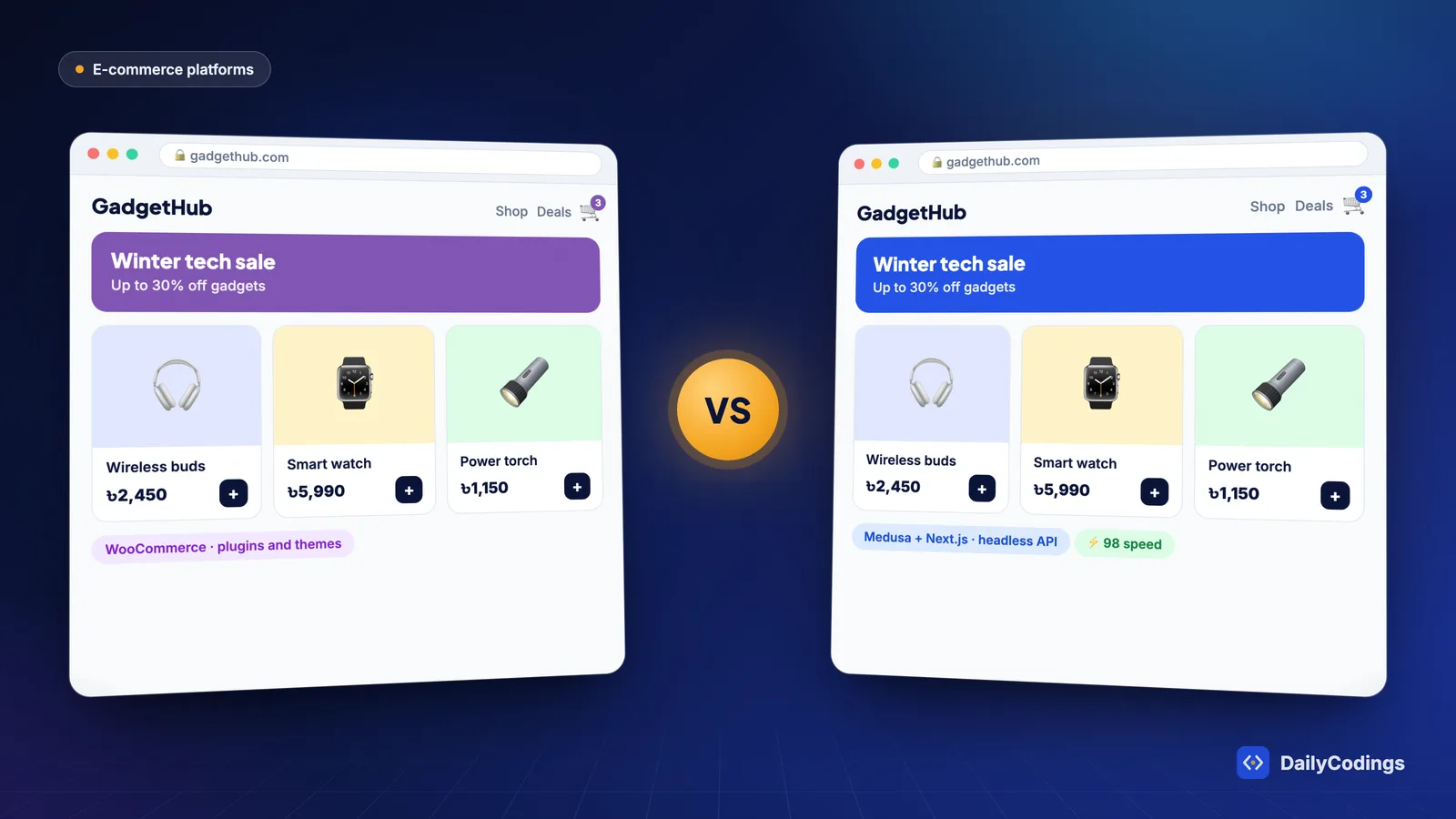
When a business asks us to build an online store, one question comes up almost every time: should we use WooCommerce, or go headless with Medusa and Next.js?
We recently prepared an e-commerce proposal that offered a client both options side by side, because the honest answer depends on the business, not the technology. This article shares how we think about that choice, so you can make it with confidence.
The short answer
- Choose WooCommerce if you are launching a new brand, want to start selling quickly, and need to keep the initial budget and running costs low.
- Choose Medusa + Next.js if you already expect high traffic or order volume, need custom business workflows, or plan to add a mobile app and other sales channels.
For most new brands, we recommend starting with WooCommerce. The rest of this article explains why, and when that advice changes.
What is WooCommerce?
WooCommerce is a free, open-source e-commerce plugin for WordPress, and one of the most widely used store platforms in the world. It turns a WordPress site into a full online store with products, a cart, checkout, orders, and stock management.
Because WordPress and WooCommerce are so popular, there is a plugin for almost everything: payment gateways, couriers, SEO, reviews, coupons, and more. Store owners manage everything from the familiar WordPress dashboard.
What is Medusa + Next.js?
This combination is a headless setup, which means the shop's engine and the shop's front end are separate:
- Medusa is an open-source commerce engine built with Node.js and TypeScript. It handles products, pricing, carts, orders, customers, and stock, and it comes with its own admin dashboard. It stores data in PostgreSQL and exposes everything through an API.
- Next.js is a React framework used to build the storefront that customers see. Pages can be pre-rendered and served from a fast global network, which makes them load very quickly.
Because the storefront talks to Medusa through an API, the same backend can also power a mobile app, a point-of-sale system, or a marketplace integration later.
Side-by-side comparison
| WooCommerce | Medusa + Next.js | |
|---|---|---|
| Best for | Launching quickly on a controlled budget | Speed, custom features, and long-term scale |
| Time to launch | Shorter | Longer, often 1.5 to 2 times as long |
| Upfront cost | Lower | Higher |
| Page speed | Good, with caching and tuning | Excellent, with pre-rendered pages |
| Customization | Through themes and plugins | Fully custom, with no plugin limits |
| Admin panel | WordPress dashboard, familiar to many | Medusa Admin, clean but newer |
| Mobile app later | Possible, but limited | Ready, through the same API |
| Hosting | Standard WordPress hosting | Cloud server, PostgreSQL, and Redis |
| Running cost | Lower | Higher |
| Developer availability | Very wide | Specialist (Node.js and React) |
Where WooCommerce wins
Speed to market. A WooCommerce store can be designed, built, and launched much faster, because so much is ready-made. For a new brand, getting real customers and real sales data early is worth a lot.
Lower total cost. The build costs less, standard WordPress hosting is affordable, and many extensions are free. That leaves more budget for products, photography, and marketing.
An easy admin for your team. Many people have used WordPress before. Adding products, processing orders, and running a coupon campaign are quick to learn.
A huge ecosystem. Whatever you need, there is likely a plugin for it, and plenty of developers who can help.
Good performance for most catalogs. A store with a few hundred to a few thousand products runs well on WooCommerce with good hosting, page caching, optimized images, and regular maintenance. Modern WooCommerce versions also store orders in dedicated database tables, which helps busy stores.
The trade-offs
- Every plugin adds code to update and secure, so maintenance matters
- Heavy customization can turn into a fight with themes and plugins
- Speed depends heavily on hosting quality and careful tuning
- Very high traffic or complex workflows can push it to its limits
Where Medusa + Next.js wins
Excellent speed. Pre-rendered Next.js pages load quickly even on slow mobile connections. Faster pages improve both conversions and Core Web Vitals, which Google uses as a ranking signal.
Full control. There are no theme or plugin limits. Custom pricing rules, approval flows, bundles, B2B features, or unusual checkout steps can be built exactly the way the business works.
Built for growth. The API-first design scales to large catalogs and high traffic, and the same backend can serve a website, a mobile app, and other sales channels.
Modern, maintainable code. TypeScript, a clear module system, and automated deployments make the codebase easier to extend safely over the years.
The trade-offs
- Higher upfront cost and a longer build
- Hosting needs a Node.js server, a PostgreSQL database, and Redis, which costs more than shared WordPress hosting
- Fewer ready-made integrations, so some features must be built
- You need developers with Node.js and React experience to maintain it
Selling in Bangladesh: payments and delivery
For stores selling in Bangladesh, local payments and couriers matter as much as the platform itself. Customers expect bKash, card payments through a gateway such as SSLCommerz, and cash on delivery. Orders then need to reach couriers such as Steadfast or Pathao, with delivery charges that differ inside and outside Dhaka.
Both stacks can do all of this, but the effort is different:
- WooCommerce often has existing plugins for local gateways and couriers, which shortens setup. Check that any plugin is actively maintained before relying on it.
- Medusa usually needs custom payment and courier modules built against each provider's API. That takes longer, but it gives you full control over how payments, order statuses, and SMS notifications behave.
A simple way to decide
Ask yourself these four questions:
- Are you still testing your products and market? If yes, launch on WooCommerce and learn fast.
- Do you already expect high daily traffic or order volume? If yes, Medusa's performance and scalability start to pay for themselves.
- Do you need workflows that do not fit a standard store? Custom pricing, B2B ordering, or complex fulfillment favor Medusa.
- Is a mobile app or multi-channel selling on your roadmap within a year or two? If yes, an API-first backend like Medusa avoids a rebuild later.
If you answered "yes" only to the first question, WooCommerce is almost certainly the right start.
Can you start on WooCommerce and move later?
Yes, and it is a sensible path. Products, customers, and order history can be exported and migrated to a new platform when the business outgrows its first store. Plan for it by keeping your product data clean and well structured from day one: consistent names, specifications, categories, and images make any future move far easier.
There is also a middle ground: keep WooCommerce as the backend and build a separate Next.js storefront on top of its API. This brings some of the speed benefits of headless while keeping the familiar admin, though it adds complexity of its own.
Our recommendation
For a new brand, start with WooCommerce. You launch sooner, spend less, and your team can run the store from day one. With good hosting, tuning, and regular maintenance, it will serve a growing catalog well.
Choose Medusa + Next.js when growth, custom workflows, or new sales channels are already part of the plan. It costs more upfront, but it gives you the strongest foundation for the long term.
Whichever you choose, the fundamentals matter more than the platform: a fast, mobile-friendly design, a simple checkout, trusted local payment options, and solid technical SEO.
Planning an online store?
We build stores on both WooCommerce and Medusa with Next.js, including local payment and courier integrations. Learn more about our e-commerce development services, or tell us about your store and we will help you choose the right stack.
Frequently asked questions
Is WooCommerce good for a new online store?
Yes. For most new brands, WooCommerce is the quickest and cheapest way to start selling, with plugins for payments, shipping, and marketing.
What is Medusa?
Medusa is an open-source, headless commerce platform. It handles products, carts, orders, and payments through an API, while a separate front end, often built with Next.js, controls how the store looks and works.
Can I start on WooCommerce and move to Medusa later?
Yes. Many brands launch on WooCommerce and move to a headless setup when traffic, order volume, or custom requirements grow. Products, customers, and orders can be migrated, with redirects to protect search rankings.
Does WooCommerce support bKash and cash on delivery in Bangladesh?
Yes. WooCommerce supports cash on delivery out of the box, and plugins exist for local gateways such as bKash and SSLCommerz. Check that a plugin is actively maintained before relying on it.
Written by
Forhad, Lead engineer at DailyCodings
Forhad builds the systems behind DailyCodings' client work: web scraping pipelines, ETL and data platforms, workflow automations, dashboards, and AI-assisted tools, mostly in Python.
- Python development
- Data engineering
- Web scraping
- Automation
- AI workflows
- Dashboards