- Web Scraping
- Pricing
- Data Engineering
How Much Does a Custom Web Scraper Cost in 2026?
Compare a $250–$400 one-site scraper with a dataset or managed feed. Model first-year cost, staff time and the price per usable record before commissioning a build.
By DailyCodings TeamUpdated 7 min read
For a straightforward custom scraper, $250–$400 is a useful starting benchmark. Broke to Built publishes that estimate for one public site and up to ten fields. ScrapeNow separately lists $350 as its starting price for a build with source-code handover. These are advertised offers in US dollars, checked on November 24, 2026. DailyCodings quotes each project after reviewing the sources and delivery requirements. Broke to Built pricing · ScrapeNow build pricing
For a larger build, Broke to Built lists $600–$1,000 for up to three sites with scheduling and change tracking, and $1,200–$2,500 for four or more sites or one difficult source. Its care plan is $99–$299 per month, plus compute. A $1,200 estimate would be high for the simple one-site example. It becomes easier to justify when the quote names the additional work, such as matching product variants across catalogs, validating updates and alerting someone when a feed breaks. Broke to Built project and care estimates
If you just need the output, Talha Pythoneer advertises a one-off dataset from $100. Octoparse lists one-time data delivery from $699 with cleaning and a quality report, or ongoing monitoring from $599 per month. Ask both suppliers to price the same sample and acceptance criteria before drawing a conclusion from those starting prices. Talha Pythoneer dataset pricing · Octoparse data service pricing
What do you need to receive?
| If your team needs… | Ask the supplier to include… | Who does the next run? |
|---|---|---|
| A spreadsheet for a market study | One dated export, agreed fields, duplicate checks and a list of gaps | Request another export if the study repeats. |
| A scraper an engineer can operate | Source code, a working sample, setup instructions and a walkthrough | Your team runs it and owns repairs after the agreed support period. |
| Fresh data in a CRM or dashboard | A delivery schedule, field checks, alerts and a process for replacing a missed delivery | The supplier runs the feed under the agreed service terms. |
If your only deadline is a board meeting on Friday, a clean spreadsheet may finish the job. If your sales team starts every Monday from that list, someone also has to notice when the source returns half the usual records and get the missing rows back to sales.
What makes two scraping quotes different?
The number of different sources. Ten thousand listings that share one page layout can be simpler to collect than 500 listings spread over ten unrelated directories. Send one typical URL and one awkward example from each source. If an official export or API already contains the fields you need, ask the supplier to price that route too.
How often the data has to be fresh. Checking 5,000 product pages once a week means 5,000 page checks per week. Checking the same pages every day means 35,000, before retries. Ask whether the provider charges per page request, successful record, unit of compute time or scheduled delivery. The unit matters when prices change more often than the rest of the page.
What counts as a usable record. In a DailyCodings project for the UK financial-services market, the automation checked HubSpot for an existing company domain before creating a record. It created more than 200 records on its first live day after testing. A buyer requesting that workflow needs a price for matching prospects to existing CRM records as well as extracting the data and updating the CRM. Read the UK prospect-data case study
Who pays when a source changes. Two quotes can include “maintenance” and cover different work. Ask each supplier what happens if a directory renames a field on Thursday and Friday’s delivery is incomplete. Who notices, who repairs it, who reruns the missing records, and which of those steps appear on the next invoice? See how DailyCodings checks scraping data quality
A worked budget for a weekly feed
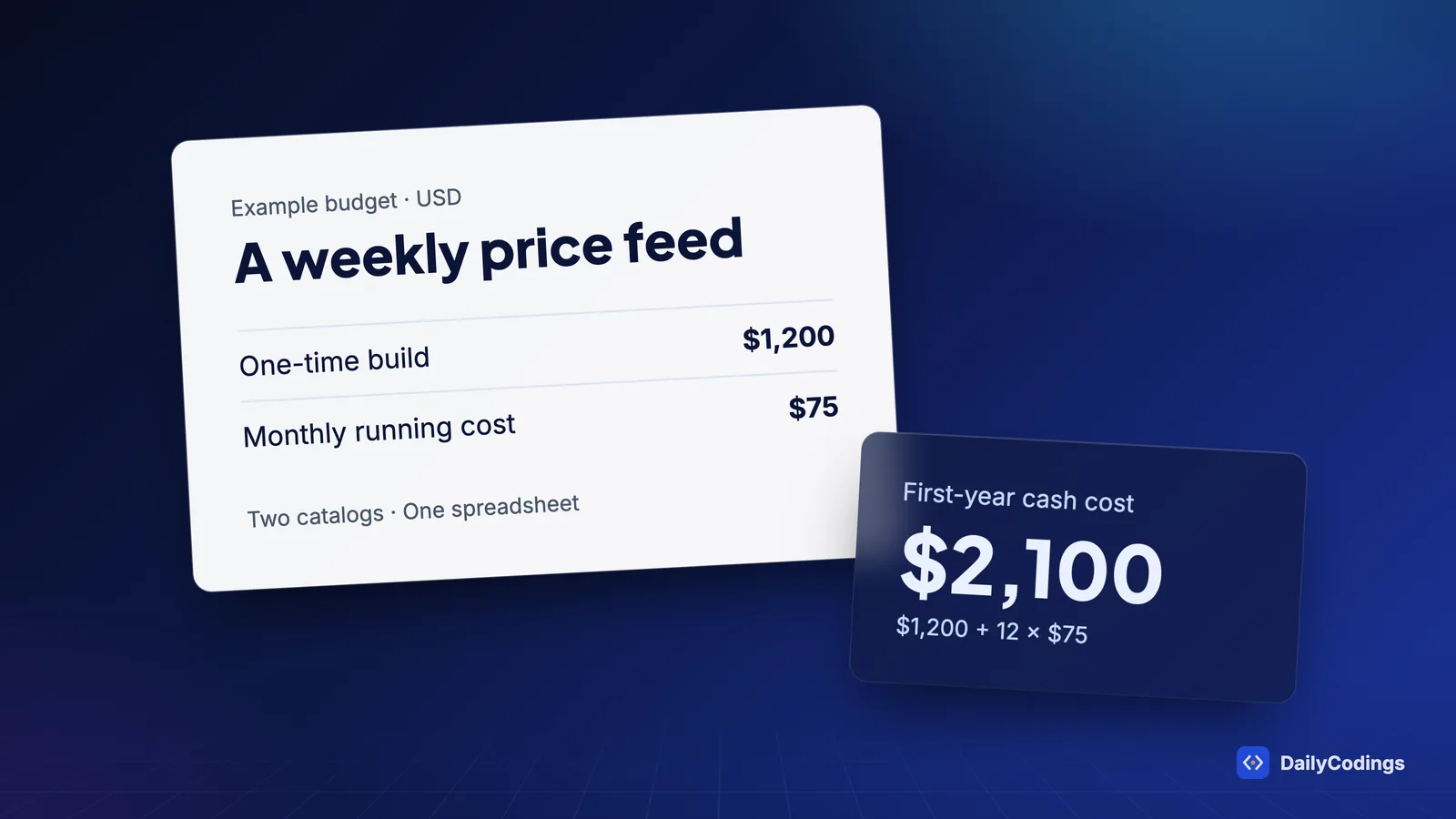
Suppose you need prices from two public product catalogs delivered to one spreadsheet every Friday. Each catalog names its product variants differently. Both suppliers will match them to your product IDs and flag unmatched rows for review. The following illustrative quotes cover that same scope. Use the arithmetic with your own quotes. All figures are USD, before tax.
| Cost | Buy the scraper and run it | Buy a managed feed |
|---|---|---|
| One-time setup | $1,200 | $300 |
| Monthly cost | $75 for hosting and usage | $225 for operation and agreed repairs |
| First month, including setup | $1,275 | $525 |
| First year, including setup | $2,100 | $3,000 |
At six months, both options cost $1,650 in cash. After a year, running the scraper yourself costs $900 less before staff time. At an assumed internal cost of $50 per hour, 18 hours of monitoring and repair over the year uses that entire saving. If a quote also charges separately for storage, access to a licensed data source or historical backfills, add those items before comparing totals.
For a one-time study, use a shorter calculation. Divide the total quote by the number of accepted, distinct records. For example, a $600 export with 2,000 accepted records costs $0.30 per usable record. Define whether a row with a missing required field counts before comparing per-record bids.
A paid sample can settle which scraper quote is cheaper
Take a retailer comparing two bids for competitor prices. It needs the price of the matching pack size, the currency, stock status and the date observed. A low bid can look attractive if it returns every product page, even when half the rows describe a different quantity. Before agreeing a monthly schedule, give both suppliers the same small sample, including a sale price, an unavailable item and two variants with similar names. Ask them to show which values they can substantiate and where they would leave a field blank.
| Illustrative sample bid | Delivered rows | Accepted, distinct matches | Cost per accepted match |
|---|---|---|---|
| $120 for a file of page results | 400 | 200 | $0.60 |
| $160 with variant matching and exception notes | 350 | 320 | $0.50 |
The second supplier has the higher invoice and the lower cost per usable match. If your analyst must also spend two hours checking the first file at an internal $30 per hour, its effective cost rises to $0.90 per accepted match. The answer could change for a one-off research exercise that needs only a broad sample. Define the business decision before defining a billable row.
For a recurring feed, include one more acceptance condition. Ask the supplier to flag a price that falls from $100 to $1 on the same item and explain whether it is a genuine promotion, a different pack or a missing decimal. If a buyer uses the feed to recommend prices, preventing one bad recommendation can matter more than collecting another thousand pages. Request the sample, the disputed rows and a separate quote to operate the feed after the pilot.
What to send for a comparable quote
- Sources and fields. Include one or two public sample URLs per source and a sample output row. Mark the fields you need on every record.
- Volume and timing. Estimate the first delivery size, how far back the data must go and when updates need to arrive.
- Destination and acceptance. Specify CSV, Google Sheets, database or CRM. Explain how to handle missing values, existing records and a missed run.
- Ownership and support. Ask for separate amounts for setup, normal monthly operation and additional repairs. State whether your team needs the source code and who should operate it after handover.
For example, a team might specify, “If a company already exists in HubSpot, update the industry and source date, keep our account owner, and send uncertain matches to review.” A supplier can test that instruction against a sample and price the same work as the next bidder.
Frequently asked questions
Can I buy the data once without paying a monthly scraper fee?
Yes. Ask for a one-time extraction with a fixed delivery format, an agreed list of fields and an acceptance sample. If you want to rerun it yourself later, ask whether source code and setup instructions are included.
What should a web scraper maintenance fee cover?
Ask who monitors missing or unusual records, repairs the scraper after source changes and reruns missed deliveries. Check the included repair hours, the response window and how extra work is billed.
Can DailyCodings quote my project from a sample URL?
A representative public URL is a good starting point. Include the fields you need, approximate volume, delivery destination and refresh frequency. If you need a CRM update, tell us how to identify an existing record.
Written by
DailyCodings Team
DailyCodings is a software development and digital studio. We design and build websites, online stores, custom software, automation, and data systems, and help businesses grow with digital marketing.
Meet the team